International Political Economy — What Is It and Why Does It Matter?

English: 2010 HDI (Very High) nations graph by...

English: 2010 HDI (Very High) nations graph by population size and region (Photo credit: Wikipedia)

The social science concept of International Political Economy is a measure of a nation‘s law, politics and economics — and their effect on each other, and it’s worth to the world.  While this sounds complicated, it really isn’t, particularly if you think about the simple phrase itself.

In some aspects, it’s exactly what you think of when you think of how “strong” a nation is, particularly when you compare them socio-economically.  When you hear phrases such as “Nation A is stronger than Nation X,” or “Nation C has a stronger swing in the world than Nations G, E and F.”

Why is this an important thing to consider?  This is the measure of the whole machine: politics, law, the nation’s military industrial complex, state control of the economy and political freedoms work together (…or against) the rest of the “machine” of the country.  A country can have an extremely strong military, but with little social freedoms, this could very well work against the forward momentum of the nation if it’s regime is looking forward (as most of them are…).  However, another theoretical nation with a weaker military, but a strong Gini index and a strong Human Development Index may have a stronger IPE because the Grand Strategy of the nation is more in tune with what the people want in a democratic society.

It’s a simple concept — that has a complicated and involved explanation.  There’s a lot to know.  Check it out, there’s all sorts of really cool theories.  Everything from Marxist IPE theory to Realist IPE theory.

JPMorganChase plans, axes Twitter Q&A after #Ohsh!t moment…

JPMorgan1

JPMorganChase Vice Chairman Jimmy Lee was all set to use their official Twitter account, @JPMorgan to answer questions posed to the banking giant using #AskJPM.  The seemingly innocuous move turned immediately to panic as apparent distrust, anger and indeed simple trolling immediately took over the hashtag.

Several hours later, JPM retracted the idea.
Image

Why did this become such a problem?

Aside from simple internet trolling, public confidence in America‘s banking system remains low — and indeed, possibly even contemptuous.  Even I stopped myself from submitting the following question:

“Why did you purchase new jets and hangars for them while you received $25 Billion of my money? Wasn’t it because you were in trouble and needed help? Or was it because you screwed America, and you knew it and wanted to get away with it again? #TARPFunds #BankingCrisis #AskJPM

I still don’t trust the banking system — particularly after having worked in it for several years from the mortgage backed securities side.  Consumers get ripped off at every opportunity, and while improvements have been made, it’s a system of ethics and thought that drives the industry to produce “more, more, more; and damn everything else!”

…like any rabidly for-profit market, I guess.

The one family you’ve probably never heard of… who’ve influenced your life the most

English: The heraldic achievement of the House...

The House of Medici


The Medici Family of Italy is probably something you’ve never heard of, unless you’re involved in high finance, politics, or the academic sides of each… but they’ve likely influenced your life more than you’ll ever know.

The Medici family rose to prominence during the 14th century in Florence, getting very wealthy off the textile and later, further gathering power in the Kingdom’s local governments. At the time, their seemingly unstoppable rise continued onward and upward, to the point where they founded the Medici Bank, the largest and most notable bank of the 15th Century of Italy.

Why is this so important? The Medici family not only produced FOUR Catholic popes (Popes Leo X, Clement VII, Pius IV and Leo XI) — but it also made massive contributions to accounting and finance methodology — including the advent of the dual-book accounting system and overall improvements of the general ledger. Many of these improvements are still used by public and management accountants even today!

Coat of Arms of the Medici Family. based on Ar...

Coat of Arms of the Medici Family


Arguably, the Medici’s were the most wealthy family in Europe, and among the most powerful — effecting policy, religion and even banking methodology that’s still in use today. Next time you balance your checkbook, take a minute, and think about how the whole system of finance works, and where it came from… and look into it! You’d be surprised how the simple methods we use today to balance our sheets were revolutionary just a few hundred years ago…

Why did I leave Business to become a Theorist…

Socrates-1-

The Death of Socrates

“…an unexamined life is not worth living.”
 — Socrates

It’s question I’ve gotten a lot when I’ve been bouncing it off the minds of my more intellectual friends…

“Why would you not get a graduate degree in business?”
“There’s more money in business.  You want to study philosophy?!”

I’ve asked myself the same questions a lot, particularly the last year or so.  Yeah…  you definitely don’t get a degree in the humanities or social sciences and expect to make a lot of money — but I found myself going “Businessmen and businesswomen are a dime a dozen in the world today.  Indeed, they’re going to be flooding the marketplace by the time I graduate,” which is true.  Not only do I have my past successes in business as armament on a resume, but I started looking to the future…

With my experience in business, I can still teach business if I so want to; however, I think teaching the basics of political philosophy and ethics in politics could be just as important to preventing the next financial or political calamity as any business professional could be, teaching the equivalent courses.  Indeed, studying our past mistakes and failures makes us better able to prevent another Lehman Brothers‘ or Subprime Mortgage crisis or S&L Scandal.  Teaching the values of a balanced approach to policy in business, and business in policy I think is just as important, as well.

My main goal since I was a kid was to teach — even when I went into the private sector for awhile, first in mortgages, then in security as a manager, now working for a Fortune 500’s Health Safety and Environmental Department while I continue schooling…   I realized that studying our political past and the successes and failures in it lend just as much understanding as studying the great economists and financiers of our past and present does.

If maybe one day, one of the students I inspire goes forth to be a little more ethical, and blows the whistle on an unfair banking practice, or other social justice issue, or even something as simple as being a little more ethical in his or her business practices by having a sense of social responsibility and social justice, but still being profitable in his or her business — I think I’ll have done my part.

More and more the past several years, my drive has shifted from a sense of being educated more in business to more a sense of social justice.  I learned I was more interested in learning about business for the sake of my OWN knowledge, than applying it toward something I could use in the future.  When I found myself studying political or social justice issues…  particularly the work I’m doing right now as a Research Analyst and Intern with The SERO Project…  this is the stuff that actually matters.   The fact I retain information from a Business Communication course doesn’t *mean* anything, aside from the fact I can write kickass resumes and letters.  Helping myself and my friends better themselves is an awesome thing to be able to do…  but, when it comes to social science and social justice… this stuff actually MATTERS.

I was lucky enough to grow up in a home in the top 5% of income in the United States.   I’m well taken care of, essentially, the rest of my life, even if I fall flat on my face a dozen times.  I’ve lived in some of the nicest places in the country — I’ve gone to some of the best schools our nation has to offer — including Eastern’s prestigious College of Business.  I have a family who’s always been there, and I have access to many resources and avenues the average person does NOT.  I’ve had everything I’ve ever wanted, essentially…  even if I had to wait awhile for it.  Studying and working on behalf of the social sciences, particularly social justice, I think is not only a calling, but a duty of mine to perform — and it’s something I’m loving more and more, and have more and more a passion for as the days go by.  While I don’t have a wish at this time to be directly “in” politics, I’d love to be a back-office player someday…  maybe a policy analyst, or a Chief of Staff who offers a sounding board to a legislator or other person who’s decisions matter — to be right there, in the thick of it, when the opinions and the research actually count for something OTHER than lining your own pockets.

This is what I’m going to do.  Let’s get it done.

The most distant galaxy found yet… …and it’s FAR.

English: The , atop Mauna Kea, Hawai'i

The Keck Observatory, at Mauna Kea, Hawaii 

Almost by accident, we’ve discovered the most distant intergalactic body yet; and it’s by no means close to us.

Designated z8_GND_5296, it was discovered by a combination of infrared and and deep optical telescopes by astronomers from from University of California, Riverside, in conjunction with the at the National Optical Astronomy Observatories University of Texas at Austin and Texas A&M University.  This was confirmed by imagery from the telescope at the Keck Observatory in Hawaii.

By examining the redshift of the galaxy, that is, the shift in light color produced by a moving object, similar to the doppler shift heard in a racecar as it passes by you, this shift allows astronomers and physicists to determine how fast and how far away an object is, as the shift distorts the image more and more to the infrared end of the spectrum.  With a redshift of 7.51, and knowing the distance of the intergalactic objects between us and and that galaxy, we’ve been able to extract that the galaxy is over thirty BILLION light years away; and we are seeing it today as it appeared 13.1 Billion Light Years away.

What an incredible find!  When they say our universe is a big place, they mean it!

China’s call for a “De-Americanized” Future?

317b5967cf5b1b4ca8849bfa3f7f89e52a4d4aeeWhile this would, no doubt, be disastrous for the American economy, which is vastly based on the “full faith and credit of the United States government” of the United States dollar — could China’s own less-than-impartial statement that the future of the world should be “de-Americanized” have a point?

Partisan infighting in Congress, on top of massive trade deficits with China and Japan (among others) are threatening the faith the world has in the US government’s ability to pay the debts it has already racked up — even in simple interest payments on Treasury Bills and other things.

While there’s yet been a default on any obligation of the United States, if partisan gridlock doesn’t change in Washington, could it be an inevitable future?

Those on the right say our borrowing to fund the government and to pay our obligations say this is an unsustainable model do have a point.  Borrowing forever with no intention to fix it will only result in a catastrophic failure — sooner or later.

However, liberal economics specifically state that when the economy is in a recession, or otherwise growing at an anemic rate, that it is the government’s duty to pump money into the economy to ensure that consumer confidence remains high and that people spend — particularly during problems like high unemployment or lower consumer confidence, the two silver bullets to economic futures.  When people are scared (fiscally speaking) they withhold money; and not spending money grinds the economy to a halt.  Very effectively.

Are both goals mutually exclusive?  I don’t think so.

While a plan to begin to work down our debt obviously needs to be in place, because consumer confidence still hasn’t fully recovered from The Great Recession, this is where [neo?]liberal economics comes in.  Adaptive economics, in particular.  The economy “running itself,” particularly without any regulation, obviously doesn’t work as much as an authoritarian, centrally planned economy.  A government buffer helps “prop up” the economy, while the wheels of the private sector continue to spin.

It’s a mess, but it’s one we can fix — if we come together and work the problem… and not just point fingers — and America can still be a leader in the world.

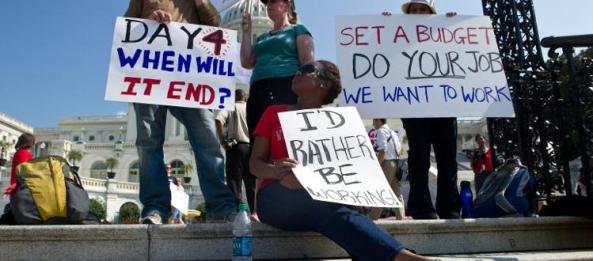
#2013Shutdown’s effect on Business and the Future of America…

Professor David Victor, Ph.D.

Professor David Victor, Ph.D.

One of my former (and future, no doubt!) professors from Eastern Michigan University, Dr. David Victor, posted this morning about a possible future oil boom for Iceland, noting that a recent survey and discovery shows Iceland sits on a *LOT* of the possible undiscovered oil reserves in the world, estimates place it at 13%.  With the thawing of the northern ice cap, and the North Atlantic Current keeping ice from marring up the major ports of the island nation, all of these things could conspire to bring a well-needed boon to it’s economy.

However, another follower on Facebook of Dr. Victor, the Chair of CitrinGroup, also threw in his two cents, stating that while the Chinese are courting and betting on future oil producers, such as Iceland, the United States, already suffering an anemic economy, is wasting it’s time on policy matters that in the grand scheme of things, don’t really matter.  I tend to agree.

The United States’ economy is JUST starting to  gain traction, while sitting fairly stationery and spinning it’s wheels, begging to move forward since the crisis began in the Subprime Mortgage market in 2007.  We’re finally starting to see forward momentum beyond the familiar numbers of “0.04% gains.”  People are beginning to feel confident in the economic system again.

However, when people see the Government itself can’t get it together and pay it’s OWN bills, that’s when people begin to hold onto their OWN money, going “What if I find myself right back in 2008 again?”  I admit, I found myself thinking twice when I made a relatively small purchase this morning, because the well-being of MY household budget is determined by the fiscal health of the Federal Government.

When recessions and slumps hit the nation, the Government is there to provide relief, to buffer the blow with benefits, stimulus and other some-such capital, by pumping money into the system.  However, if that money is cut off too soon, the economy can slump again.  Bad news breeds bad feelings.  Bad feelings breed either a binge on spending, or a lack of spending, more often, the latter.  When people stop spending, the economy grinds to a screeching halt — as we saw starting with the credit freezes of 2008.  While one can argue the merits of policy on both sides of the aisle, the latest budgetary and policy debate is doing nothing but killing consumer confidence, and indeed, making foreign markets question the stability of the American economy.

While Obamacare is certainly an expensive program, so was the F-35 Fighter — which estimates have the cancelled fighter costing as much as a trillion dollars — a number often attributed to the cost of Obamacare.  Oddly enough, I haven’t heard it mentioned once by Republicans on the Hill, even though it is now essentially a great waste of capital and expenditures.

Who’s right?  Who knows.  One thing I do know is — #2013Shutdown can be a death knell for the fragile traction the American economy took years to get.

A Government Shutdown… what it means, and why you should care…

download“Due to the failure of Congress to enact appropriations for fiscal year 2014, Office of Management and Budget Director Sylvia Mathews Burwell tonight directed agencies to execute their plans for an orderly shutdown of the Federal government.”

Continue reading

My Knee-Jerk Review: The Pebble Watch

ImageI got my Pebble watch today!   Right out of the box, I felt the quality and the care of craftsmanship put into this item.  It’s obvious that the designers of the watch cared as much foe aesthetics and ergonomics as they did about functionality.  It’s an absolutely beautiful, functional device that compliments any professional.  The black version, which I got, goes with any wardrobe and is as much stylish as it is sedate.

While I won’t go into too many details without a video of my own, I wanted to show you what I did with mine, and how I like it.  The video reviews I post here are VERY realistic and pretty much spot-on.

Video Reviews:

– Engadget: http://www.youtube.com/watch?v=VGzdqqkQ0IA
– TechSmartt: http://www.youtube.com/watch?v=Z42vxp1ywMU
– SoldierKnowsBest: http://www.youtube.com/watch?v=uOVX00e9_oc
– Selim Akca: http://www.youtube.com/watch?v=wdgIz8X8Qsk

Of course, I had to have my Star Trek watch-face.  😀

20130923_164408