2700 Planets so far…

An artist's depiction of an extrasolar, Earthl...

An artist’s depiction of an extrasolar, Earthlike planet. (Photo credit: Wikipedia)

NASA’s Kepler Observatory satellite has discovered over 2700 exoplanets so far…  and counting.  Most of these are super-earths — however, there’s a lot more there, according to the people who run it.

Ames Research Center scientists have the Observatory’s Photometer observes 145,000 Main Sequence stars simultaneously, looking for the slightest dimming of the stars that indicate an orbital body.  Of these, 114 have been actually confirmed and observed, one of them is a Mars-sized planet.

Ames also believes that, based on the observed planets, with the confirmations in mind, that the galaxy is full of Earth-sized planets.

Yale Astronomy Professor Debra Fisher, who has worked on improving the planet-detecting technology we have today to detect Earth-sized planets, says it’s only a matter of time before we detect life on other planets; specifically, those in the ‘habitable zone‘ of the stars they observe — that is, the area that’s “just right” in light and temperature, for life to flourish.

Do you think we’ll find alien life in our lifetime?

Gay bashing… what would Hobbes and Locke say?

English: Thomas Hobbes Македонски: Томас Хобс ...

English: Thomas Hobbes, John Locke and Jean-Jacques Rousseau (Photo credit: Wikipedia)

Being a theorist, I like taking time to think about the world today… and what those who helped shape the thoughts and philosophies we study as a science today would think about them.

With a recent rash of gay beatings and bashings, I’m often taken back to two of my favorite  founders of western political thought, Hobbes and Locke; and often think about what they would say about it, among other things going on in the world today.

quote-open“In Locke’s state of nature, things aren’t so bad!  In Hobbes’ state of nature, it’s DEADLY.”
        — Professor Laurel Sprague


I come back to the ideology of each theorist’s state of nature — where, in all things being equal, Man is at his most primal when it comes to social governance.  There’s no government to tell them what to do; Man, essentially, has all the rights one could ever want.

Locke’s State of Nature is a pretty laid back utopia of “I respect your boundaries, you respect mine, and we’re all happy.”  There are a few commonly understood rules that society in and of itself lives by.  Hobbes, however, it a bit more of a free-for-all.  Things are a lot more “an eye for an eye, a tooth for a tooth,” to coin a phrase from The Bible.

In a Lockeian State of Nature, I don’t see such a thing happening.  It would go against the very point of Locke’s theory of Nature in and of itself.  People don’t inherently harm others in his world.

Hobbes, on the other hand, is dramatically different.  If a group of straight guys were to beat up on a gay guy, Hobbes would be the first to say that it’s quite likely a group of gay guys would want retribution and blood for the blood spilled of their brother… either the guys who committed the bashing itself, or just a target to prove a point.

What’s the most likely to occur if we were thrust into a State of Nature today?

DUI at 0.05 as opposed to 0.08 justice or overreaching?

drunk-driving-stop-293x300The National Transportation Safety Board (“the NTSB”) wrote a report today recommending all 50 states in the United States lower the level of driving under the influence from 0.08 to 0.05 Blood-Alcohol Content.  The responses from each side of the argument have been interesting to say the least. Swift action, including the revocation of driver licenses was also indicated as a punishment to those to keep repeat offenders from becoming habitual drunk drivers.

The report published by the NTSB also noted that lowering the intoxication threshold would save anywhere from “500 to 800 lives per year.”

Indeed, there is precedence for this figure.  A decade ago, the laws were changed to criminalize driving under the influence at 0.08 BAC.  Alcohol-related deaths on the road plunged from 20,000 in 1980 to 9,878 in 2011.

Even the lowest levels of alcohol seem to impair drivers, the NTSB has said.  In an NTSB study, people were given alcohol and drove in simulators.  At 0.01 BAC, drivers in simulators demonstrate attention problems and lane deviations. At 0.02, they exhibit drowsiness, and at 0.04, vigilance problems.

quote-open“This recommendation is ludicrous,” Sarah Longwell, managing director of the American Beverage Institute, said in a statement to CNN.

“Moving from 0.08 to 0.05 would criminalize perfectly responsible behavior. …A little over a decade ago, we lowered our legal limit from 0.1 percent after groups like Mothers Against Drunk Driving assured the country that, based on all the science, 0.08 BAC was absolutely, unequivocally where the legal threshold should be set for drunk driving. Has the science changed? Or have anti-alcohol activists simply set their sights on a new goal?” Longwell asked.

Are Athlete Fraudsters Liable for Reimbursing Funders?

Lance Armstrong finishing 3rd in Sète, taking ...

Lance Armstrong finishing 3rd in Sète, taking over the Yellow Jersey at Grand Prix Midi Libre 2002 (Photo credit: Wikipedia)

Late Tuesday afternoon, the United States Government filed a lawsuit against former Olympic-Gold Medalist cyclist Lance Armstrong, citing the fact that he defrauded them out of millions of dollars in his doping campaign.

The Government, citing the False Claims Act, state that he defrauded the United States Postal Service by doping, and under that law, the USPS is, technically entitled to triple the amount of funds spent, or money in excess of US$120 Million; as the Government is contesting US$40 Million.

The United States asserts in its suit that a use of performance enhancing drugs is a violation and breach of contract of the agreement he signed with the USPS, originally in 1998 – through 2004.

Should any entities who chose to fund people be entitled to collect monies if they were unable to  prove during that time that the athlete/etc in question was doping, or taking other performance enhancing drugs?  While I agree it’s a great deterrent, when people make bad investments, often they are told they “are out of luck.”

Could such a ruling, for instance, be worked into such a precedent as Bankers and Executives for financial companies making and funding bad loans to be held responsible for them; and repayment as well?

The Earth is Burning…

centralia

Literally.  In Centralia, Pennsylvania USA that is, anyway.

In 1979, a local gas station owner dipped a stick into one of his fuel tanks to check the level of gas he had to sell.  When he pulled it back up, he noticed it was extremely warm — and subsequently lowered a thermometer on a string to the bottom of the tank for a few minutes.  Bringing it back up, he was extremely alarmed to find the temperature of his fuel to be over 170 degrees Fahrenheit.  Shortly after, in another part of town, a 12 year old boy fell into a sinkhole that opened below his feet — thankfully saved by another boy, as the steam coming out of the hole was filled with lethal levels of carbon dioxide.

This drew state and eventually federal attention to the fact that Centralia, a mining community, had a MASSIVE fire burning beneath their feet — literally below the ground itself, and it was so large, nothing humanly feasible could stop it.

The fire was traced to a mine event in 1962 where the anthracite in an active mine caught fire, and was abandoned and collapsed for protection.  What people didn’t know was that the fire raged on… and subsequently; and somehow, spread to the abandoned mines under Centralia… and continued burning.  Anthracite is, in a way, self-oxidizing, and can burn without direct oxygen feed from the surface — something that has been demonstrated by this fire for the last 51 years.

Panoramic view of Route 61 through Centralia, PA

Panoramic view of Route 61 through Centralia, PA (Photo credit: Wikipedia)

In 1992, when the State of Pennsylvania learned of the threat to life brought by the fire and the damage it was causing property, the Governor of Pennyslvania at the time, Bob Casey, invoked the laws of eminent domain and declared the entire borough of Centralia — stating that the entire town’s buildings were to be condemned, and all people were to be relocated and compensated.   While most left without much question, many chose to stay, including Centralia’s Mayor, Carl Womer — who continues to serve as Mayor.  While a very few homes remain, almost all of them have been demolished by the county authority or by nature itself.  Some residents remain as well, but against the advice and indeed, order of the state’s executive.

Since 1992, the Anthracite fire has spread to the mines beneath the neighboring town of Byrnesville, which was completely abandoned with the last home was torn down in 1996,  Scientists believe that the fire could continue to burn for at least another century before it will self-extinguish by depleting the anthracite, and could very well have burned for 200 years by the time it ceases.

Higgs Boson: Mission Accomplished!

An example of simulated data modelled for the ...

An example of simulated data modelled for the CMS particle detector on the Large Hadron Collider.

It looks like the verdict is in: we’ve finally found the Higgs Boson — one of the most elusive particles; with the exception of Dark Matter, in nature.  Science has theorized of it’s existence for years, but it was always just beyond our grasp.

Today, we’ve finally confirmed the existence of what we believe is the Higgs Boson.  Last July, physicists and scientists from the European Organization for Nuclear Research, or known more properly by it’s French acronym CERN, announced that it’s Large Hadron Collider (or LHC) had conducted a particle acceleration test that revealed the presence of a subatomic particle that had the distinctiveness of what physicists postulated as the characteristics of the elusive particle.

Why is the Higgs so important?  So what?  In essence, the Higgs is, according to Gauge theory published in 1964, gives all conventional matter “mass.”  The average particle of matter contains mass, no matter how minuscule.  However, items of other types of matter, such as neutrinos which are able to pass right through solid matter without being interrupted, and the ever-elusive dark matter, seem not to have this subatomic particle in it’s makeup, according to the math.  Dr. Michio Kaku explains more here why the Higgs is so important.

With the numbers all working out, Science has finally [mathematically and now, via observation] proven the existence of the Higgs Boson.  How was such a feat accomplished, nearly 50 years after it’s postulation?

With the Large Hadron Collider, of course!  The largest particle accelerator on Earth, and in human history, the LHC is so large, it stretches through the border of France and Switzerland;

Large Hadron Collider

Large Hadron Collider (Photo credit: Randall Niles)

and remains one of the largest and most complex structures ever to be built by humankind.  Indeed, it’s literal atom-smashing power is in excess of 7 Tetra-electron volts (7 TeV) — or, to put it in some sort of perspective, a single visible photon of light is approximately 3.4 electron volts.  One Tetra-electron volt is 10E12, or ten to the twelfth electron volts.  Indeed, the atom-smashing power of this collider exceeded the previous most-powerful smasher by over seven times.  Some theorists postulated the idea that the LHC, at full power, had enough power to create a black hole if atoms were smashed at full intensity.  Luckily, this seems to have been proven wrong.

What has been proven right on the other hand, has effectively proven that we’re on the right track, and further, have taken another step toward understanding our universe.

What else is out there?  What more do we have to learn?  Plenty, I feel.

The Future of Technology — Licensure?

English: Apple director Steve Jobs shows iPhone

English: Apple director Steve Jobs shows iPhone (Photo credit: Wikipedia)

Google recently announced (likely only for it’s developer-model) that if you receive a Google Glass  — it’s only for you.  Nobody else.  You can’t even loan it.

Indeed, the Terms of Service for it clearly state:

quote-open“…you may not resell, loan, transfer, or give your device to any other person. If you resell, loan, transfer, or give your device to any other person without Google’s authorization, Google reserves the right to deactivate the device, and neither you nor the unauthorized person using the device will be entitled to any refund, product support, or product warranty.”

While I assume that this is because it’s still a developing product, and it’s to keep people from making massive amounts of money by placing them on an auction site like eBay or something else; likely making a major profit.

It made me wonder if this, along with what Apple tried to do with the iPhone — is that you’re not buying the ITEM itself, you’re buying a LICENSE to USE the item, and the manufacturer maintains control and ownership.  Apple successfully did this until a lawsuit ended “part” of this, exactly how, I’m still not entirely sure how it works… but it does make one wonder:

Is the future of technology and hardware in licensure of USE, not OWNING the hardware itself? Will we be paying hundreds or even thousands of dollars simply for a right to use something we don’t even own? What does this say about our future privacy, as well?

Guantanamo Bay Prison — The 21st Century Manzanar?

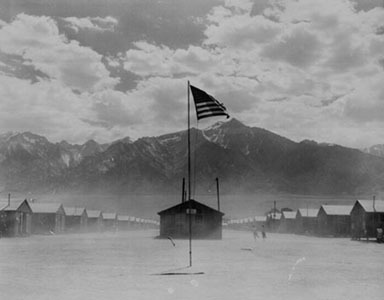
ImageThe more and more I give thought to it — the more and more I wonder if history will look back on our generation, and judge the indefinite imprisonment of those at Guantanamo Bay, Cuba as our version of Manzanar.

Japanese Issei, Nisei or Sansei were often the most targeted group for forced relocation during World War II — relocated almost strictly due to their lineage, family ties, or just because they even looked Japanese.  Other groups were forced to relocate as well, but Japanese Issei and Nisei were the groups targeted the most.

Thankfully, none of the prisoners at Guantanamo are children or family members; but many similarities exist: they are not afforded a civil trial, as the prisoners have been designated as “unlawful military combatants,” in that while they are not a member of a recognized, uniformed military service, they either conduct, have been trained to conduct, or otherwise engage in or support militarized warfare.  However, interestingly enough, the Center for Constitutional Rights and Human Rights Watch maintain that the United States has not held the Article 5 tribunals required by the Geneva Conventions. The International Committee of the Red Cross has stated that, “Every person in enemy hands must have some status under international law: he is either a prisoner of war and, as such, covered by the Third Convention, a civilian covered by the Fourth Convention, [or] a member of the medical personnel of the armed forces who is covered by the First Convention. There is no intermediate status; nobody in enemy hands can fall outside the law.”

I do give the United States Intelligence Community credit when I say that they are privy to information about these people that we, as civilians, do not know.  It’s quite possible these people are as dangerous as the US Government says they are — why otherwise hold them?  But…  why is there a[n apparent] lack of jurisprudence for these people?  Do those who fall between the cracks of the law just sit there, and wait for a trial that may never come?  Will history look back on Guantanamo Bay Detention as a necessary evil, and something that kept the United States safe?

Or…

Image

…will it be a stain of blood on our hands that even time can’t wash away?

CISPA passes in a closed-door session… uhh…

cispaSOPA failed to pass last year because of a MASSIVE internet uproar that made it so politically toxic, even co-authors pulled their support.

This time, John Boehner‘s House Intelligence Committee is doing a good job of keeping it’s successor, CISPA, very quiet — and indeed, passing it with as little noise as possible.

Passing in a vote of 18-2 in the House Intelligence Committee, one of the dissenters to the bill, Rep. Jan Schakowski (D-IL) specifically voted against it, because she wished to attach riders to the bill that, among other things:

Image

Rep. Jan Schakowski (D-IL)

“…would have strengthened privacy protections, ensured that consumers can hold companies accountable for misuse of their private information, required that companies report cyber threat information directly to civilian agencies…  I strongly agree with the need to enact effective cyber-security legislation… but this bill doesn’t sufficiently protect individual privacy rights.”

When she proposed these amendments above, she was overruled in Committe, saying that the amendments were not acceptable.  Moreover — the bill amends the National Security Act of 1947, a law that, while arguably, needs constant “boning up,” to keep the law up to date with those who would go “around the law” to harm American citizens.

If this is such a horrible problem — particularly with American citizens, why is a warrant unnecessary?  Why are your browsing histories, your private email, and your other digital rights now any less meaningful than your other privacy rights?

Law Enforcement needs a warrant to enter your home… and right now, Law Enforcement needs a warrant to access your private documents, browsing history, and your other private digital information.  CISPA, essentially says, “no longer necessary.”

I find this highly disturbing.  Does anybody else?  If you’re as disturbed by this as I am, call your members of Congress, both the Senate AND the House — and demand a NO vote on this nonsense.

Personally, I think they don’t get to play with privacy rights on the internet until they fix… oh, I don’t know… THE DEFICIT?  Maybe the Fiscal Cliff disaster, too?

A good video with further information -> The Young Turks – 12 April 2013: “What Privacy?  CISPA Passes in Closed Door Vote.”

Samuel’s hidden love: Physics

One of my favorite passions that I don’t get a chance to get into often with others, is physics — particularly quantum physics.  I’ve had a love of what makes the universe tick since I was a kid watching Star Trek: The Next Generation, and trying to wrap my head around the idea of Warp Drive.

One of my favorite theories of what makes the universe tick is “Where did we come from?  Is this all there is — is there anymore than what we see?”  We now know there is matter beyond the subatomic, particularly if you, like me subscribe to String Theory.

ImageThe Multiverse theory is the the ideology that says our universe isn’t the only one out there.  Our universe exists like a bubble in an ocean filled with other bubbles.  Each bubble has it’s own laws of physics, some are compatible with our own, others are not.  For instance, one may be a universe filled with a liquid.  Others, like ours, contain a vacuum of dark matter.  Others may be a solid mass.  Another ideology of the multiverse is the idea of parallel universes; in which all possible outcomes that can happen DO happen — in another universe.  For instance, there is the possibility YOU are the President of the United States.  Another could be where you weren’t born at all.  This is only one possible theory of the multiverse.

ImageOne of the physicists that helped bring the idea of the multiverse to the mainstream in theoretical physics is one of my favorite scientists, Dr. Michio Kaku.  Dr. Kaku is often referred to as “the man who made theoretical physics understandable for everyone.”   Indeed, as a young man, he asked his mother for permission to build a nuclear accelerator in his garage as a science fair project.  His other agreed — and he built a reactor so massive, that, once he plugged in and flipped the switch, to which the device drew so much power, that it blew EVERY fuse in the service box in their home.  A short time later, the son who blew the the service box in the house out of commission wound up getting a scholarship to Harvard; from which he graduated summa cum laude.  Today, he is the Professor of Theoretical Physics at City College of City University of New York.  In his teaching capacity, he’s delivered countless lectures on the matter, including his futurist philosophies of time travel, travel between universes, the multiverse theory itself, and the physics and technology of the future.

I love learning about what makes things work… even the [multi?]universe we all live in.