The Earth is Burning…

centralia

Literally.  In Centralia, Pennsylvania USA that is, anyway.

In 1979, a local gas station owner dipped a stick into one of his fuel tanks to check the level of gas he had to sell.  When he pulled it back up, he noticed it was extremely warm — and subsequently lowered a thermometer on a string to the bottom of the tank for a few minutes.  Bringing it back up, he was extremely alarmed to find the temperature of his fuel to be over 170 degrees Fahrenheit.  Shortly after, in another part of town, a 12 year old boy fell into a sinkhole that opened below his feet — thankfully saved by another boy, as the steam coming out of the hole was filled with lethal levels of carbon dioxide.

This drew state and eventually federal attention to the fact that Centralia, a mining community, had a MASSIVE fire burning beneath their feet — literally below the ground itself, and it was so large, nothing humanly feasible could stop it.

The fire was traced to a mine event in 1962 where the anthracite in an active mine caught fire, and was abandoned and collapsed for protection.  What people didn’t know was that the fire raged on… and subsequently; and somehow, spread to the abandoned mines under Centralia… and continued burning.  Anthracite is, in a way, self-oxidizing, and can burn without direct oxygen feed from the surface — something that has been demonstrated by this fire for the last 51 years.

Panoramic view of Route 61 through Centralia, PA

Panoramic view of Route 61 through Centralia, PA (Photo credit: Wikipedia)

In 1992, when the State of Pennsylvania learned of the threat to life brought by the fire and the damage it was causing property, the Governor of Pennyslvania at the time, Bob Casey, invoked the laws of eminent domain and declared the entire borough of Centralia — stating that the entire town’s buildings were to be condemned, and all people were to be relocated and compensated.   While most left without much question, many chose to stay, including Centralia’s Mayor, Carl Womer — who continues to serve as Mayor.  While a very few homes remain, almost all of them have been demolished by the county authority or by nature itself.  Some residents remain as well, but against the advice and indeed, order of the state’s executive.

Since 1992, the Anthracite fire has spread to the mines beneath the neighboring town of Byrnesville, which was completely abandoned with the last home was torn down in 1996,  Scientists believe that the fire could continue to burn for at least another century before it will self-extinguish by depleting the anthracite, and could very well have burned for 200 years by the time it ceases.

Higgs Boson: Mission Accomplished!

An example of simulated data modelled for the ...

An example of simulated data modelled for the CMS particle detector on the Large Hadron Collider.

It looks like the verdict is in: we’ve finally found the Higgs Boson — one of the most elusive particles; with the exception of Dark Matter, in nature.  Science has theorized of it’s existence for years, but it was always just beyond our grasp.

Today, we’ve finally confirmed the existence of what we believe is the Higgs Boson.  Last July, physicists and scientists from the European Organization for Nuclear Research, or known more properly by it’s French acronym CERN, announced that it’s Large Hadron Collider (or LHC) had conducted a particle acceleration test that revealed the presence of a subatomic particle that had the distinctiveness of what physicists postulated as the characteristics of the elusive particle.

Why is the Higgs so important?  So what?  In essence, the Higgs is, according to Gauge theory published in 1964, gives all conventional matter “mass.”  The average particle of matter contains mass, no matter how minuscule.  However, items of other types of matter, such as neutrinos which are able to pass right through solid matter without being interrupted, and the ever-elusive dark matter, seem not to have this subatomic particle in it’s makeup, according to the math.  Dr. Michio Kaku explains more here why the Higgs is so important.

With the numbers all working out, Science has finally [mathematically and now, via observation] proven the existence of the Higgs Boson.  How was such a feat accomplished, nearly 50 years after it’s postulation?

With the Large Hadron Collider, of course!  The largest particle accelerator on Earth, and in human history, the LHC is so large, it stretches through the border of France and Switzerland;

Large Hadron Collider

Large Hadron Collider (Photo credit: Randall Niles)

and remains one of the largest and most complex structures ever to be built by humankind.  Indeed, it’s literal atom-smashing power is in excess of 7 Tetra-electron volts (7 TeV) — or, to put it in some sort of perspective, a single visible photon of light is approximately 3.4 electron volts.  One Tetra-electron volt is 10E12, or ten to the twelfth electron volts.  Indeed, the atom-smashing power of this collider exceeded the previous most-powerful smasher by over seven times.  Some theorists postulated the idea that the LHC, at full power, had enough power to create a black hole if atoms were smashed at full intensity.  Luckily, this seems to have been proven wrong.

What has been proven right on the other hand, has effectively proven that we’re on the right track, and further, have taken another step toward understanding our universe.

What else is out there?  What more do we have to learn?  Plenty, I feel.

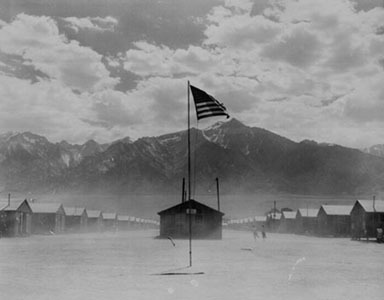
Guantanamo Bay Prison — The 21st Century Manzanar?

ImageThe more and more I give thought to it — the more and more I wonder if history will look back on our generation, and judge the indefinite imprisonment of those at Guantanamo Bay, Cuba as our version of Manzanar.

Japanese Issei, Nisei or Sansei were often the most targeted group for forced relocation during World War II — relocated almost strictly due to their lineage, family ties, or just because they even looked Japanese.  Other groups were forced to relocate as well, but Japanese Issei and Nisei were the groups targeted the most.

Thankfully, none of the prisoners at Guantanamo are children or family members; but many similarities exist: they are not afforded a civil trial, as the prisoners have been designated as “unlawful military combatants,” in that while they are not a member of a recognized, uniformed military service, they either conduct, have been trained to conduct, or otherwise engage in or support militarized warfare.  However, interestingly enough, the Center for Constitutional Rights and Human Rights Watch maintain that the United States has not held the Article 5 tribunals required by the Geneva Conventions. The International Committee of the Red Cross has stated that, “Every person in enemy hands must have some status under international law: he is either a prisoner of war and, as such, covered by the Third Convention, a civilian covered by the Fourth Convention, [or] a member of the medical personnel of the armed forces who is covered by the First Convention. There is no intermediate status; nobody in enemy hands can fall outside the law.”

I do give the United States Intelligence Community credit when I say that they are privy to information about these people that we, as civilians, do not know.  It’s quite possible these people are as dangerous as the US Government says they are — why otherwise hold them?  But…  why is there a[n apparent] lack of jurisprudence for these people?  Do those who fall between the cracks of the law just sit there, and wait for a trial that may never come?  Will history look back on Guantanamo Bay Detention as a necessary evil, and something that kept the United States safe?

Or…

Image

…will it be a stain of blood on our hands that even time can’t wash away?

Property Zoning… Past Residential, does it matter?

Proposed_LU_ranges_July 7 2007I’ve been working on a small research project for a couple of months on Zoning ordinances and people’s trust in the government.  While I’ve noticed no major correlation, it has raised an interesting point I thought I’d share.

While I’ve always understood the need for Zoning residential property — as it ensures the ground is not contaminated, or otherwise unsafe for residences, why are there oodles upon oodles of commercial or industrial zoning regulations, aside from the fact that, say, a nuclear power plant can’t sit next to a farm?  That much I get…

But for instance, say an adult store, or a strip club (which I’m using as an example in my paper, actually) wants to open its doors in a particular city.  I can understand people’s desire not to have one in their town…  but — instead of having a government board tell an otherwise-legal [assuming it is in that area] business owner, who is conducting business that s/he can’t open the business there… why can’t people just *not* patronize it?

Further, again, leaving out safety issues such as a nuclear waste facility next to a cattle farm — is this just an example of local government trying to just appropriate things JUST for the sake of appropriating them?  Is telling a car-wash that it can’t open next to a library when the land has been bought and paid for and the business owner follows rules like the reasonable person should — that “Your business can’t be there”?

Again, just food for thought…  discuss amongst yourselves… or here.  😀

CISPA passes in a closed-door session… uhh…

cispaSOPA failed to pass last year because of a MASSIVE internet uproar that made it so politically toxic, even co-authors pulled their support.

This time, John Boehner‘s House Intelligence Committee is doing a good job of keeping it’s successor, CISPA, very quiet — and indeed, passing it with as little noise as possible.

Passing in a vote of 18-2 in the House Intelligence Committee, one of the dissenters to the bill, Rep. Jan Schakowski (D-IL) specifically voted against it, because she wished to attach riders to the bill that, among other things:

Image

Rep. Jan Schakowski (D-IL)

“…would have strengthened privacy protections, ensured that consumers can hold companies accountable for misuse of their private information, required that companies report cyber threat information directly to civilian agencies…  I strongly agree with the need to enact effective cyber-security legislation… but this bill doesn’t sufficiently protect individual privacy rights.”

When she proposed these amendments above, she was overruled in Committe, saying that the amendments were not acceptable.  Moreover — the bill amends the National Security Act of 1947, a law that, while arguably, needs constant “boning up,” to keep the law up to date with those who would go “around the law” to harm American citizens.

If this is such a horrible problem — particularly with American citizens, why is a warrant unnecessary?  Why are your browsing histories, your private email, and your other digital rights now any less meaningful than your other privacy rights?

Law Enforcement needs a warrant to enter your home… and right now, Law Enforcement needs a warrant to access your private documents, browsing history, and your other private digital information.  CISPA, essentially says, “no longer necessary.”

I find this highly disturbing.  Does anybody else?  If you’re as disturbed by this as I am, call your members of Congress, both the Senate AND the House — and demand a NO vote on this nonsense.

Personally, I think they don’t get to play with privacy rights on the internet until they fix… oh, I don’t know… THE DEFICIT?  Maybe the Fiscal Cliff disaster, too?

A good video with further information -> The Young Turks – 12 April 2013: “What Privacy?  CISPA Passes in Closed Door Vote.”

Political Comebacks… Are they possible?

265005_10151214146056817_1276640492_nMany political careers — particularly in the late 20th and this, the early 21st century thus far, have ended in embarrassing ruin.  Bill Clinton, leaving office with some of the highest presidential approval rates in history, is often cited for jokes such as “having made the word ‘blowjobpolitically correct,” or having all sorts of goofy images posted of him that would otherwise be looked over as innocuous.  On the other hand, George W. Bush left office with among the lowest approval ratings in history — but in his retirement, the vehement rhetoric launched toward him, and his dismal approval ratings, have been softened by time.

Other political post-mortems have been much more hilarious.  Former Congressman Anthony Wiener resigned in disgrace after he accidentally posted a photo of himself on Twitter; which blew open a scandal of himself sending less-than-fully-clothed pictures of himself to women online.  Having resigned nearly two years ago, he’s now looking at making a comeback as a candidate for the Mayor of New York.

George W. Bush has essentially retreated to a private life — arguably because of the overwhelmingly negative view the people had on his Presidency; whereas Bill Clinton, while still as polarizing, has enjoyed overwhelming public support — even in the ever-existing shadow of his own sexual scandals in office.

Are such political comebacks possible?  Could George W. Bush or Bill Clinton [or Anthony Wiener in this case!] make a comeback in a positive light, or would their scandals and disgrace continue to follow them?

SOPA + PIPA + CISPA = Congress selling out?

ImageFor at the third time, the Congress in the United States is attempting to circumvent the privacy rights of its citizens on the internet.  The first two attempts, the Stop Online Piracy Act and PROTECT IP Act failed in Congress because of overwhelming negative feedback from constituents that, was indeed so strong — that even the co-authors wound up pulling their support of the bill.

Why do Representatives in Congress keep trying to shove this type of legislation through?  Is it because of issues that Congress says, which is everything from intellectual property protection to the enforcement of trade embargoes.  OR…

SOPA author Congressman Lamar Smith, a member of the House representing the 21st District of Texas, received almost US$ 2 Million in the last reporting period, according to OpenSecrets.org.  Among his Top 5 Highest Contributors?  CC Media, Comcast and TimeWarner.  What do these companies have in common?  Oh!  Intellectual Property!

Republicans in the United States often argue that “big government” is bad for business — that “big government” today is the basis of why the American economy can’t gain significant traction post-The Great Recession.

However, government in business affairs is okay, on the other hand, when the businesses say it’s okay, apparently.  Fund a Congressman’s campaign — and all of a sudden, you can now write your own legislation, which you hand over to the Congressman’s office, and he places in the ballot box for you.  Sounds preposterous, right?

Image

Rep. Rachel Burgin     (R-FL)

Sadly, it’s not as preposterous as you may think.  Recently, a Congresswoman from the State House of Florida submitted a Bill for consideration.  In her haste to do so, however, she forgot to remove the cover sheet of the email that it came through.  Rachel Burgin’s blunder blew open the fact that the American Legislative Exchange Council actually WROTE the Bill, and gave it to Burgin to submit, to which she did… without even removing the proof that SHE didn’t write it.   [The Bill can be seen here, in it’s original format, as she submitted it — the name of ALEC is plainly visible on the first page…]

Is this an example of the leadership exhibited by our Members of Congress?  While they can’t come together to work out issues of Party and Partisanship, they quietly collect campaign contributions, and then do their bidding by submitting Bills that they write, in the name of the Representative or Senator they buy and sell like Stocks on an exchange?