Are Athlete Fraudsters Liable for Reimbursing Funders?

Lance Armstrong finishing 3rd in Sète, taking ...

Lance Armstrong finishing 3rd in Sète, taking over the Yellow Jersey at Grand Prix Midi Libre 2002 (Photo credit: Wikipedia)

Late Tuesday afternoon, the United States Government filed a lawsuit against former Olympic-Gold Medalist cyclist Lance Armstrong, citing the fact that he defrauded them out of millions of dollars in his doping campaign.

The Government, citing the False Claims Act, state that he defrauded the United States Postal Service by doping, and under that law, the USPS is, technically entitled to triple the amount of funds spent, or money in excess of US$120 Million; as the Government is contesting US$40 Million.

The United States asserts in its suit that a use of performance enhancing drugs is a violation and breach of contract of the agreement he signed with the USPS, originally in 1998 – through 2004.

Should any entities who chose to fund people be entitled to collect monies if they were unable to  prove during that time that the athlete/etc in question was doping, or taking other performance enhancing drugs?  While I agree it’s a great deterrent, when people make bad investments, often they are told they “are out of luck.”

Could such a ruling, for instance, be worked into such a precedent as Bankers and Executives for financial companies making and funding bad loans to be held responsible for them; and repayment as well?

Higgs Boson: Mission Accomplished!

An example of simulated data modelled for the ...

An example of simulated data modelled for the CMS particle detector on the Large Hadron Collider.

It looks like the verdict is in: we’ve finally found the Higgs Boson — one of the most elusive particles; with the exception of Dark Matter, in nature.  Science has theorized of it’s existence for years, but it was always just beyond our grasp.

Today, we’ve finally confirmed the existence of what we believe is the Higgs Boson.  Last July, physicists and scientists from the European Organization for Nuclear Research, or known more properly by it’s French acronym CERN, announced that it’s Large Hadron Collider (or LHC) had conducted a particle acceleration test that revealed the presence of a subatomic particle that had the distinctiveness of what physicists postulated as the characteristics of the elusive particle.

Why is the Higgs so important?  So what?  In essence, the Higgs is, according to Gauge theory published in 1964, gives all conventional matter “mass.”  The average particle of matter contains mass, no matter how minuscule.  However, items of other types of matter, such as neutrinos which are able to pass right through solid matter without being interrupted, and the ever-elusive dark matter, seem not to have this subatomic particle in it’s makeup, according to the math.  Dr. Michio Kaku explains more here why the Higgs is so important.

With the numbers all working out, Science has finally [mathematically and now, via observation] proven the existence of the Higgs Boson.  How was such a feat accomplished, nearly 50 years after it’s postulation?

With the Large Hadron Collider, of course!  The largest particle accelerator on Earth, and in human history, the LHC is so large, it stretches through the border of France and Switzerland;

Large Hadron Collider

Large Hadron Collider (Photo credit: Randall Niles)

and remains one of the largest and most complex structures ever to be built by humankind.  Indeed, it’s literal atom-smashing power is in excess of 7 Tetra-electron volts (7 TeV) — or, to put it in some sort of perspective, a single visible photon of light is approximately 3.4 electron volts.  One Tetra-electron volt is 10E12, or ten to the twelfth electron volts.  Indeed, the atom-smashing power of this collider exceeded the previous most-powerful smasher by over seven times.  Some theorists postulated the idea that the LHC, at full power, had enough power to create a black hole if atoms were smashed at full intensity.  Luckily, this seems to have been proven wrong.

What has been proven right on the other hand, has effectively proven that we’re on the right track, and further, have taken another step toward understanding our universe.

What else is out there?  What more do we have to learn?  Plenty, I feel.

Guantanamo Bay Prison — The 21st Century Manzanar?

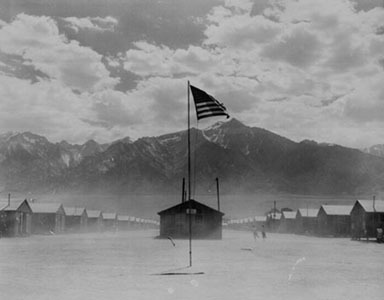
ImageThe more and more I give thought to it — the more and more I wonder if history will look back on our generation, and judge the indefinite imprisonment of those at Guantanamo Bay, Cuba as our version of Manzanar.

Japanese Issei, Nisei or Sansei were often the most targeted group for forced relocation during World War II — relocated almost strictly due to their lineage, family ties, or just because they even looked Japanese.  Other groups were forced to relocate as well, but Japanese Issei and Nisei were the groups targeted the most.

Thankfully, none of the prisoners at Guantanamo are children or family members; but many similarities exist: they are not afforded a civil trial, as the prisoners have been designated as “unlawful military combatants,” in that while they are not a member of a recognized, uniformed military service, they either conduct, have been trained to conduct, or otherwise engage in or support militarized warfare.  However, interestingly enough, the Center for Constitutional Rights and Human Rights Watch maintain that the United States has not held the Article 5 tribunals required by the Geneva Conventions. The International Committee of the Red Cross has stated that, “Every person in enemy hands must have some status under international law: he is either a prisoner of war and, as such, covered by the Third Convention, a civilian covered by the Fourth Convention, [or] a member of the medical personnel of the armed forces who is covered by the First Convention. There is no intermediate status; nobody in enemy hands can fall outside the law.”

I do give the United States Intelligence Community credit when I say that they are privy to information about these people that we, as civilians, do not know.  It’s quite possible these people are as dangerous as the US Government says they are — why otherwise hold them?  But…  why is there a[n apparent] lack of jurisprudence for these people?  Do those who fall between the cracks of the law just sit there, and wait for a trial that may never come?  Will history look back on Guantanamo Bay Detention as a necessary evil, and something that kept the United States safe?

Or…

Image

…will it be a stain of blood on our hands that even time can’t wash away?

CISPA passes in a closed-door session… uhh…

cispaSOPA failed to pass last year because of a MASSIVE internet uproar that made it so politically toxic, even co-authors pulled their support.

This time, John Boehner‘s House Intelligence Committee is doing a good job of keeping it’s successor, CISPA, very quiet — and indeed, passing it with as little noise as possible.

Passing in a vote of 18-2 in the House Intelligence Committee, one of the dissenters to the bill, Rep. Jan Schakowski (D-IL) specifically voted against it, because she wished to attach riders to the bill that, among other things:

Image

Rep. Jan Schakowski (D-IL)

“…would have strengthened privacy protections, ensured that consumers can hold companies accountable for misuse of their private information, required that companies report cyber threat information directly to civilian agencies…  I strongly agree with the need to enact effective cyber-security legislation… but this bill doesn’t sufficiently protect individual privacy rights.”

When she proposed these amendments above, she was overruled in Committe, saying that the amendments were not acceptable.  Moreover — the bill amends the National Security Act of 1947, a law that, while arguably, needs constant “boning up,” to keep the law up to date with those who would go “around the law” to harm American citizens.

If this is such a horrible problem — particularly with American citizens, why is a warrant unnecessary?  Why are your browsing histories, your private email, and your other digital rights now any less meaningful than your other privacy rights?

Law Enforcement needs a warrant to enter your home… and right now, Law Enforcement needs a warrant to access your private documents, browsing history, and your other private digital information.  CISPA, essentially says, “no longer necessary.”

I find this highly disturbing.  Does anybody else?  If you’re as disturbed by this as I am, call your members of Congress, both the Senate AND the House — and demand a NO vote on this nonsense.

Personally, I think they don’t get to play with privacy rights on the internet until they fix… oh, I don’t know… THE DEFICIT?  Maybe the Fiscal Cliff disaster, too?

A good video with further information -> The Young Turks – 12 April 2013: “What Privacy?  CISPA Passes in Closed Door Vote.”

UN on Belle Isle? Detroit had a say in this…

English: The James Scott Memorial Fountain in ...

English: The James Scott Memorial Fountain in Belle Isle Park, Detroit, Michigan, United States. (Photo credit: Wikipedia)

Back in the 40s, even during the hottest parts of World War II, the world was trying to decide exactly where to place the headquarters of the up-and-coming United Nations, a place where the nations of the world could come together in a single place and discuss everything from commerce to diplomacy.  In the midst of this, Detroit jumped right in and said “We have the PERFECT place for it!”

The place: Belle Isle.  A large island connected to Detroit, now a preserve and park, then, almost became the world’s center of diplomacy.  It’s location almost dead-on the US-Canadian border made it an ideal place in the eyes of local leaders — on both sides of the border.

Indeed, almost over night, the City of Detroit found itself in hot competition with other cities across the nation, including Boston and Chicago.

When it was decided that the Midwest was far too against the idea of Globalization than more costal areas, that, and a grant from John Rockefeller in the amount of $8.5 Million USD essentially made the deal for the City of New York.